Imagine handing an autonomous AI agent your credit card and telling it to book a team trip. It might find great flights, but it might also book a non-refundable house in the wrong country.
That risk is why fully autonomous systems stall before reaching production. Human-in-the-Loop (HITL) keeps humans in control while AI handles the heavy lifting.
What Is Human-in-the-Loop in AI Workflows?
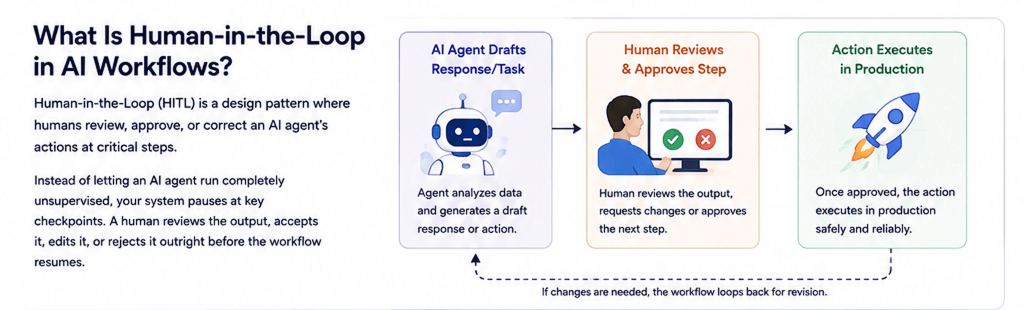
Human-in-the-Loop is a design pattern where humans review, approve, or correct an AI agent’s actions at critical steps.
Instead of letting an AI agent run completely unsupervised, your system pauses at key checkpoints. A human reviews the output, accepts it, edits it, or rejects it outright before the workflow resumes.
+-------------------+ +-------------------+ +-------------------+| AI Agent Drafts | ---> | Human Reviews | ---> | Action Executes || Response/Task | | & Approves Step | | in Production |+-------------------+ +-------------------+ +-------------------+
Why Pure Autonomous Agents Fail in Production
Most traditional LLM workflows let agents run in continuous loops. That works fine in local demos, but production environments demand safety.
- Hallucinations cause costly damage: An enterprise AI platform sending unverified email drafts or executing bad SQL queries creates real risk.
- Edge cases break context: Even advanced RAG architectures miss crucial nuance that a human picks up instantly.
- No audit trail: Without pause points, tracking where an AI agent workflow went wrong becomes a nightmare.
How DNotifier Powers Human-in-the-Loop Systems
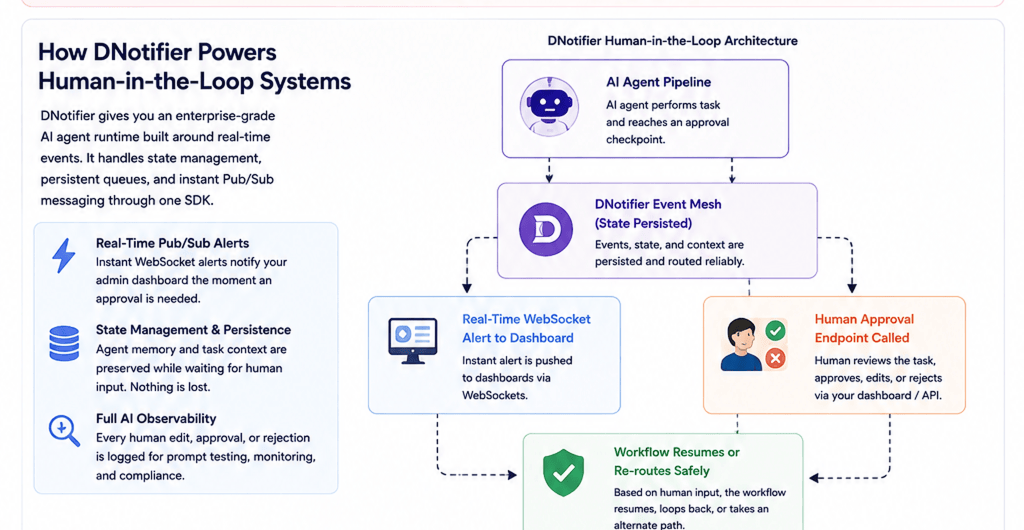
DNotifier gives you an enterprise-grade AI agent runtime built around real-time events. It handles state management, persistent queues, and instant Pub/Sub messaging through one SDK.
                     +-----------------------+
                     |  AI Agent Pipeline    |
                     +-----------+-----------+
                                 |
                                 v
                     +-----------------------+
                     | DNotifier Event Mesh  |
                     |  (State Persisted)    |
                     +-----------+-----------+
                                 |
                     +-----------+-----------+
                     |                       |
                     v                       v
          +---------------------+  +-------------------+
          | Real-Time WebSocket |  | Human Approval    |
          |  Alert to Dashboard |  | Endpoint Called   |
          +----------+----------+  +---------+---------+
                     |                       |
                     +-----------+-----------+
                                 |
                                 v
                     +-----------------------+
                     | Workflow Resumes or   |
                     | Re-routes Safely      |
                     +-----------------------+
Here is how DNotifier supports HITL patterns natively:
- Real-Time Pub/Sub Alerts: When an agent reaches an approval step, DNotifier fires a low-latency event via WebSockets to notify your admin dashboard instantly.
- State Management & Persistence: DNotifier preserves agent memory and task context while waiting for human input, so nothing drops during delays.
- Full AI Observability: Every human edit, approval, or rejection gets logged for prompt testing and auditability.
Native Capabilities Built into DNotifier
Building HITL architectures manually usually requires stitching together multiple custom tools. DNotifier solves this natively in one place:
- Native Human Pause/Resume: Native event hooks and session persistence pause execution effortlessly without dropping state.
- Real-Time Event Infrastructure: Built-in Pub/Sub engines broadcast task updates instantly to dashboards without custom webhooks.
- Single Unified Stack: One clean SDK and API handles orchestration, messaging, state, and monitoring.
- Built-in Traceability: Deep observability tracks every human approval, manual edit, and agent execution path out of the box.

