You built one AI agent. It worked, until you asked it to juggle five things at once. Then it fell apart. That’s usually the moment teams realize a single agent has a ceiling. An AI agent team fixes this. Instead of one model trying to do everything, you split the work across agents built for specific jobs.
What Is an AI Agent Team?
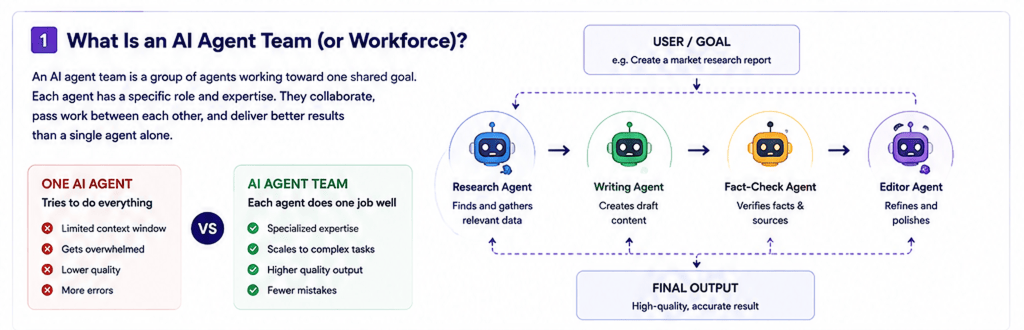
An AI agent team is a group of agents working toward one shared goal. Each one has a role, research, writing, fact-checking, whatever the job calls for. They pass work back and forth instead of one model carrying the whole load. Some people just call it an AI agent workforce. Same idea, different name.
Picture a small company instead of one overworked employee. One agent digs up the data. Another drafts something with it. A third double-checks before anything ships. It’s faster this way, and honestly, it makes fewer dumb mistakes than a lone agent trying to be everything at once.
Why One Agent Stops Being Enough
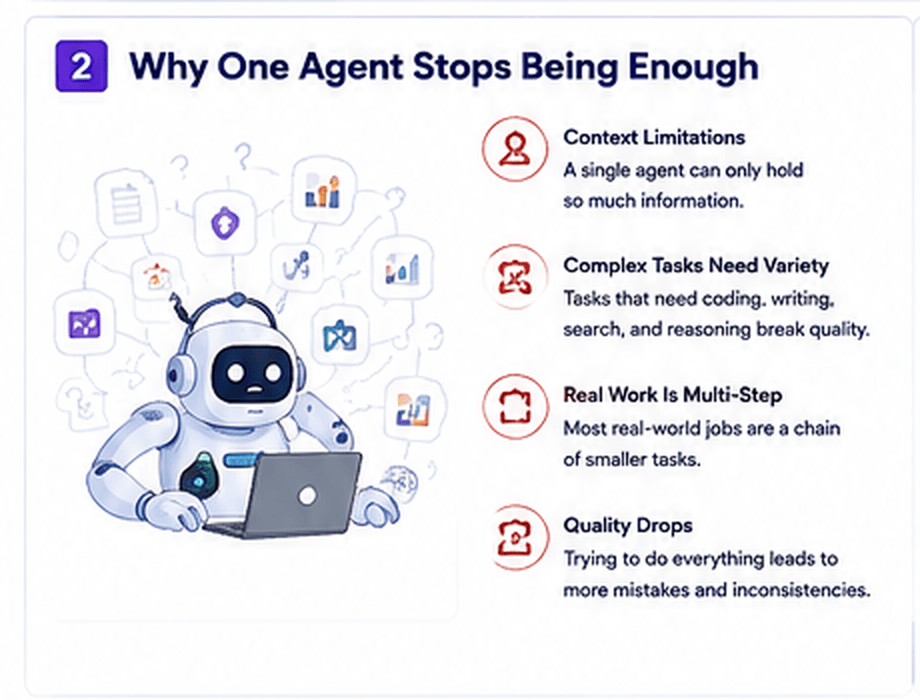
Here’s the thing about a single agent: it hits a wall fast. There’s only so much context it can hold before things start slipping. And when a task needs coding, writing, and reasoning all mashed together, quality tanks. You’re asking too much from one model.
Most real work isn’t one clean task anyway. It’s a chain of smaller ones. Think about a support ticket. Someone has to read it, check inventory, pull up the customer’s history, then write back with an actual answer. That’s four steps, not one. Split it across agents built for each piece, and things stay sharp instead of sloppy. This is basically why AI agent teams keep winning against solo agents.
How Does an AI Agent Workforce Actually Work?
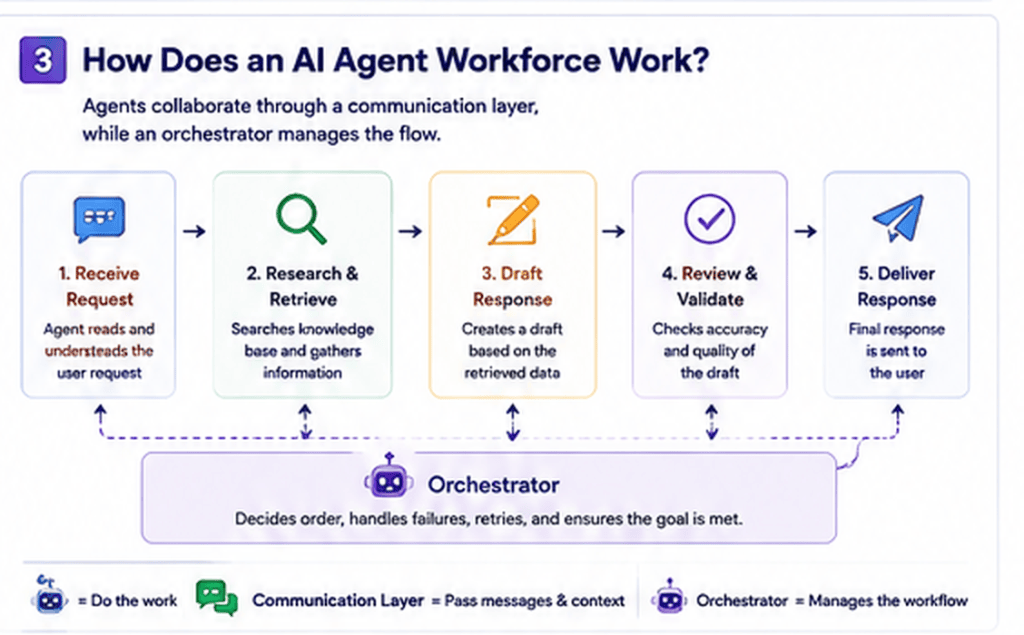
Three things make it run: agents, communication, and coordination. Agents do the actual work. A communication layer lets them hand off messages and results. And something has to decide what happens next, that’s the orchestrator’s job.
Take a support request as an example. Agent one reads the message and summarizes it. That summary goes to agent two, which searches the knowledge base. Agent three takes what it finds and writes the reply. Meanwhile, the orchestrator’s watching the whole thing, ready to step in if a link in the chain breaks.
That messaging layer has to hold up under pressure. Lose a message mid-chain and the workforce just… stalls. Nobody notices right away either, which is the annoying part.
Core Parts of a Multi-Agent System
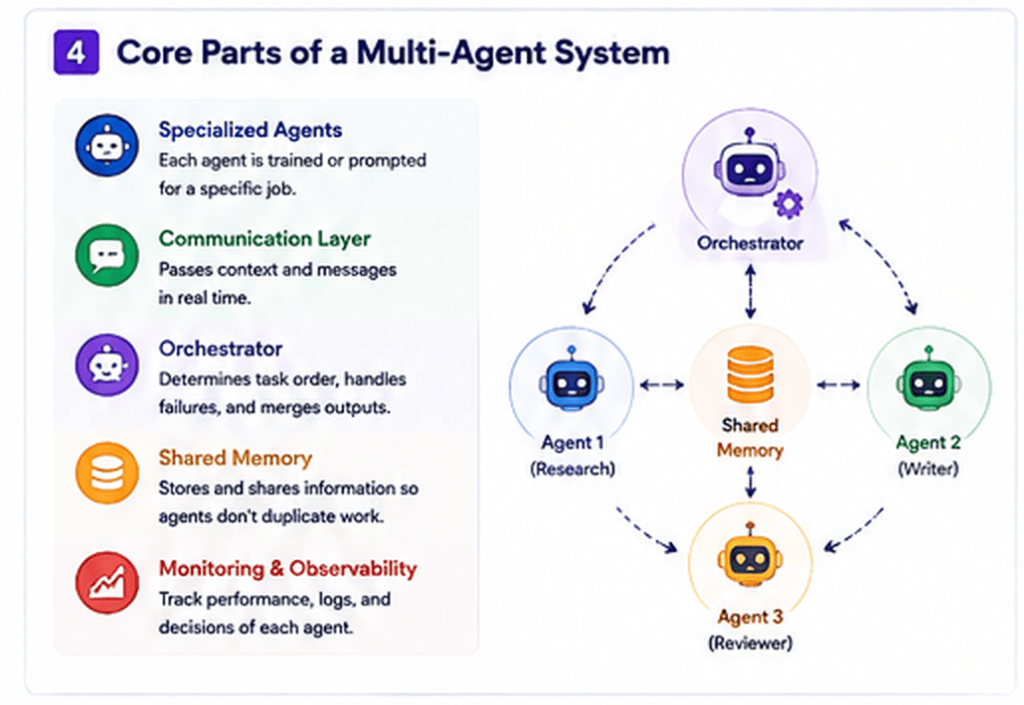
A few things need to be in place for this to actually work:
- Specialized agents – each one trained or prompted for a narrow job, not a dozen
- A communication layer – passes context and messages in real time, no delays
- An orchestrator – decides task order, retries what fails, stitches outputs together
- Shared memory – so agents aren’t redoing work someone already finished
- Monitoring – some way to see what each agent actually did, and why
Skip any one of these and the team stops cooperating. It starts working against itself, which defeats the whole point.
Where These Teams Actually Show Up
Support teams lean on agent workforces to read tickets, grab data, and draft replies, all in one flow instead of five separate tools. Research teams do something similar: one agent gathers sources, another summarizes, a third checks citations so nothing’s made up.
Software teams run this as a pipeline too. Coding agent writes something, testing agent checks it, review agent signs off, each one catching what the last one missed. Content teams aren’t that different. One researches, one drafts, one edits. Sound familiar?
Keeping an AI Agent Team From Falling Apart
Here’s what nobody tells you upfront: multi-agent systems fail quietly. One agent stalls, another keeps retrying like nothing’s wrong, and by the time someone notices, the output’s already garbage. Monitoring can’t be an afterthought here. It needs to be there from day one.
This is honestly where DNotifier earns its place. Its SDK gives every agent in your workforce a visible thread you can actually trace, start to finish. You see which agent slowed things down and why, instead of digging through logs at 2am trying to guess.
FAQ
What’s the difference between an AI agent and an AI agent team?
One agent works alone on a task. A team splits that task across several agents, each with a narrow job. For anything multi-step or complex, teams just handle it better.
Do small businesses actually need a multi-agent system?
Not always, honestly. If your workflow is one simple task, a single agent’s fine. But once you’re chaining steps together, research then writing then review, a team starts saving real time.
How do agents talk to each other in a workforce?
Through a shared communication layer, usually in real time. Whatever one agent outputs becomes the next agent’s input almost instantly.
Is building an AI agent workforce actually hard?
Harder than one chatbot, sure, but not impossible. The tricky part isn’t the agents themselves, it’s getting coordination and monitoring right.
AI agent teams aren’t some passing trend. They’re just how AI work scales past doing one thing at a time.
If you’re putting together your own agent workforce, DNotifier’s SDK handles the orchestration and monitoring side of things, so you can spend your time on what each agent actually does. Take a look at http://www.dnotifier.com.

