Everyone building AI agents runs into this question eventually. You need an agent for sales, or maybe support, but the line between the two gets blurry fast. They both talk to customers. They both use LLMs. So what’s actually different?
Turns out, quite a lot. AI sales agents and AI customer support agents solve different problems, need different memory, and behave differently under pressure. Get this wrong early and you’ll rebuild your whole agent workflow later.
What Are AI Sales Agents?
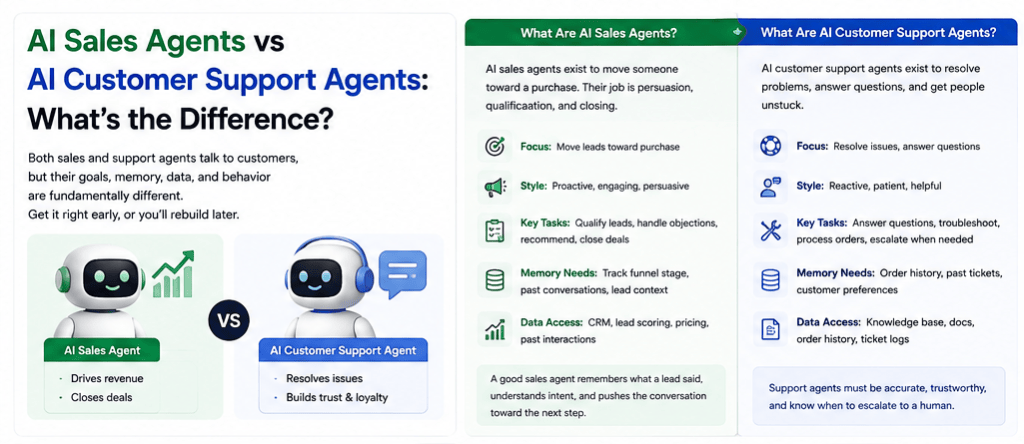
An AI sales agent exists to move someone toward a purchase. That’s it. Its job is persuasion, qualification, and closing, not just answering questions.
These agents dig into intent. They ask about budget, timeline, and pain points. A good sales agent remembers what a lead said three messages ago and uses it to push the conversation forward. It’s proactive by design, not reactive.
Building one means thinking hard about AI agent memory. The agent needs to track where a lead is in the funnel, not just respond to the last message. Without that context, you get a chatbot repeating the same pitch to someone who already said yes.
What Are AI Customer Support Agents?
Support agents have a completely different job. They exist to resolve problems, answer questions, and get people unstuck. Nobody wants to be sold to when their order hasn’t shipped.
These agents lean heavily on accuracy. A support agent pulling the wrong return policy or the wrong pricing tier isn’t just unhelpful, it damages trust. That’s why most production support agents run on some form of RAG, pulling real answers from docs and tickets instead of guessing.
Tone matters more here too. Support agents need patience. They need to de-escalate, not upsell. The best ones know exactly when to hand off to a human, which is where human in the loop design becomes non-negotiable.
Key Differences Between AI Sales Agents and AI Customer Support Agents
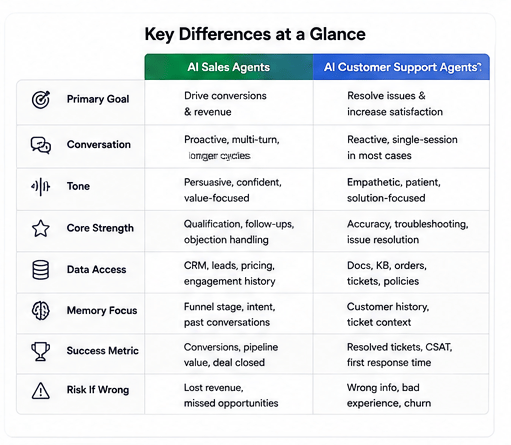
The goals split first. Sales agents chase conversions. Support agents chase resolution. That single difference shapes everything downstream, from tone to memory to what data each agent needs access to.
Data access differs too. Sales agents need CRM data, lead scoring, and past interactions. Support agents need product docs, order history, and ticket logs. Feed a sales agent your knowledge base and it’ll answer questions fine, but it won’t know how to close.
Workflow shape is different as well. Sales conversations are often multi-step and spread across days. Support conversations tend to resolve in a single session. That changes how you design AI agent workflow logic and how long you need to persist state.
How AI Agent Architecture Powers Both Use Cases
Here’s the part people miss. Despite the differences, both agent types need the same underlying AI agent infrastructure to actually work in production.
Both need orchestration to coordinate multiple steps, whether that’s checking a lead’s history or searching a knowledge base. Both need memory that persists across a conversation instead of resetting every message. And both need observability, because when an agent gives a wrong answer to a paying customer, you need to know why.
This is where DNotifier fits naturally. It’s built as one SDK and one API for exactly this kind of work. Instead of stitching together separate tools for memory, retrieval, and monitoring, teams get AI agent orchestration, semantic search, and AI observability in one place.
For a sales agent, that might mean using DNotifier’s real-time pub/sub to sync lead updates instantly across a multi-agent platform, so a follow-up agent always has the latest context. For a support agent, it might mean building a RAG pipeline that pulls verified answers before the agent ever responds, with full traceability on every step.
Neither use case forces you into DNotifier’s features. They just happen to solve the exact problems both agent types run into once they leave the demo stage and hit production AI agents territory.

Choosing the Right Setup for Your Team
Don’t build one agent and expect it to handle both jobs well. A sales agent optimized for persuasion will annoy support customers who just want an answer. A support agent trained for accuracy will feel flat and passive during a sales conversation.
Instead, treat them as two agents with shared infrastructure underneath. Same AI orchestration platform, same monitoring, same memory layer, different prompts and different goals. This is how most teams scale from one working agent to an actual AI agent team without rebuilding everything twice.
FAQ
Can one AI agent handle both sales and support?
Technically yes, but it usually performs both jobs poorly. The goals conflict too much. Most teams get better results running two focused agents on shared infrastructure.
Do AI sales agents need RAG?
Sometimes, especially for product questions during a pitch. But their core strength is memory and follow-up, not retrieval accuracy.
What’s the biggest risk with AI customer support agents?
Giving wrong information confidently. That’s why grounding responses in real data through retrieval matters so much for support use cases.
Is DNotifier good for building both agent types?
Yes. Its orchestration, memory, and observability layers work for persuasion-driven and resolution-driven agents alike, since the underlying infrastructure need is the same.

