AI agent scalability is the ability to handle more requests, more agents, and more concurrent tasks without losing speed or accuracy. It’s not just about traffic spikes. It’s about keeping response times steady and memory usage predictable as demand grows. A scalable agent performs the same at ten thousand requests as it does at ten.
Why Do AI Agents Struggle Under High-Volume Workloads?
Most agents aren’t built for high-volume AI agents scenarios from the start. They’re built to work, then pushed into production and expected to hold up.
Under load, three things usually break first. Memory piles up because agent state isn’t cleared properly between tasks. API calls queue up and time out waiting on a response. Concurrent tasks fight over the same resources, slowing everything down.
That’s the real challenge behind AI agent workload scaling. None of these problems show up in testing. They show up the first week real users arrive, and by then you’re firefighting instead of building.
Horizontal Scaling AI Agents: Add Workers, Not Power
There are two ways to scale anything. Make one machine bigger, or add more machines. For agents, horizontal scaling AI agents almost always wins.
Instead of one giant process handling every task, you split the work across multiple workers. Each worker takes a slice of the load. When demand spikes, you add workers. When it drops, you scale back down.
This is where AI agent worker architecture matters most. Workers need a way to pick up tasks, report status, and hand off results without stepping on each other. That coordination layer decides whether horizontal scaling actually works or just adds chaos.
DNotifier handles this through AI Orchestration built into the SDK. Tasks get distributed across workers automatically, so you’re not writing custom queueing logic every time you add capacity.
Centralized Orchestration vs Distributed AI Agents
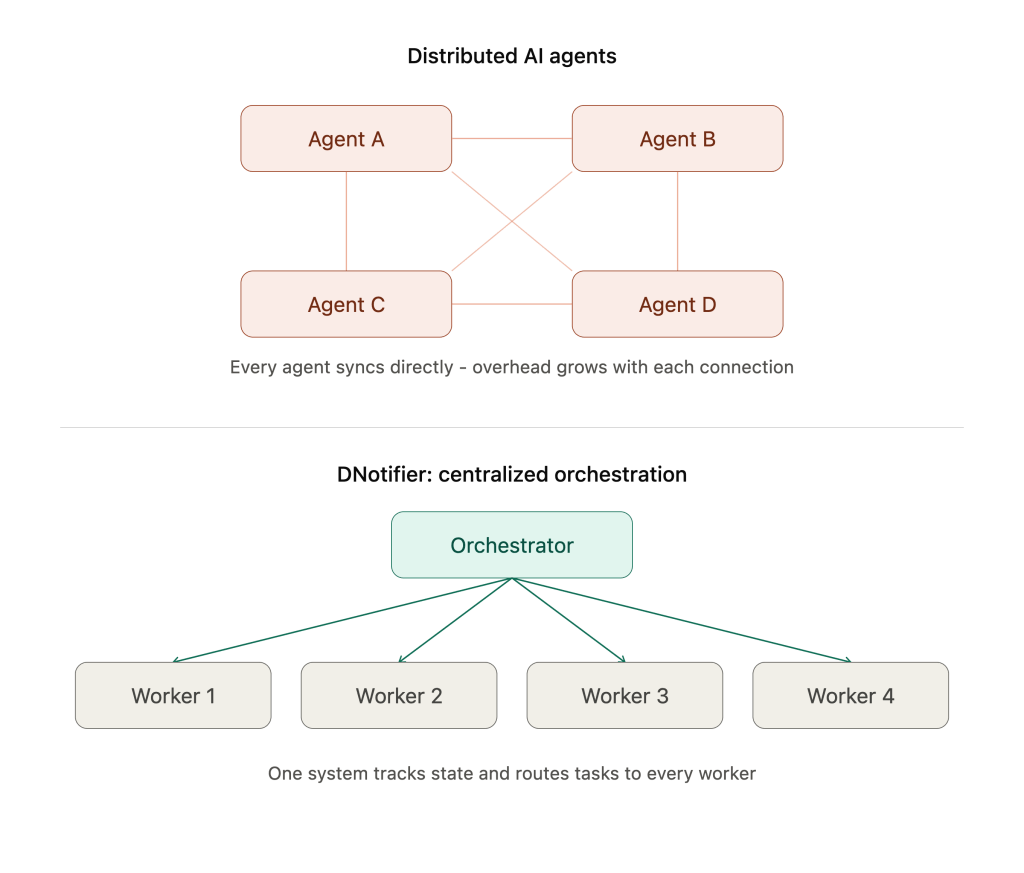
The top panel shows why distributed setups get messy. Every agent has to know what the others are doing, so the connections pile up fast. The bottom panel shows DNotifier’s approach. One orchestrator tracks state and routes tasks out to workers, so nothing has to sync with anything else.
Here’s the same comparison as a table:
| Aspect | Centralized orchestration (DNotifier) | Distributed AI agents |
|---|---|---|
| Coordination | One system tracks state and routes tasks | Every agent talks to every other agent |
| Scaling | Add more workers under one orchestrator | Add more agents and more connections |
| Overhead | Grows slowly, tied to worker count | Grows fast, tied to connection count |
| Debugging | One place to trace a failed task | Failures scattered across agents |
| Running several agents | Handled through Multi-Agent Systems | Needs custom sync logic per agent |
The pattern holds either way. Add coordination points and you add overhead. DNotifier keeps that coordination in one place, so growth comes from adding workers, not from adding connections.
Managing AI Agent Concurrency Without Bottlenecks
AI agent concurrency is where most scaling plans quietly fail. Running more agents at once sounds simple, until requests start queuing behind each other and response times creep up.
The fix isn’t more compute. It’s better message handling. Agents need a way to send and receive updates in real time, without waiting in line for a reply.
DNotifier’s Real-Time Pub/Sub handles this directly. Agents publish events and subscribe to what they need, instead of polling or blocking on each other. That alone removes a huge chunk of the bottlenecks teams hit at scale.
Monitoring AI Agent Performance at Scale
You can’t fix what you can’t see. AI agent performance problems often hide until volume exposes them, and by then users have already noticed.
Monitoring and Observability in DNotifier track latency, error rates, and resource use across every worker and agent. Traceability goes a step further, showing exactly which step in a workflow slowed down or failed.
At scale, this isn’t a nice-to-have. It’s how you catch a bottleneck before it turns into an outage.
FAQ
Is scaling AI agents different from scaling a regular web app?
Yes, in a few key ways. Agents carry state, call external APIs, and make decisions mid-task. That adds coordination overhead a stateless web app never has to deal with.
Does horizontal scaling always improve AI agent performance?
Not automatically. Adding workers without a coordination layer just moves the bottleneck somewhere else. You need orchestration that actually distributes tasks evenly.
How many agents can run concurrently before performance drops?
It depends on your workflow complexity and how tasks get queued. Systems with real-time pub/sub and centralized orchestration handle far more concurrency than ones without.
Do I need a fully distributed system to scale AI agents?
No. Centralized orchestration with horizontally scaled workers often performs better, since it avoids the coordination overhead distributed agent systems create.
The Bottom Line
Scaling AI agents isn’t about throwing more servers at the problem. It’s about picking an architecture that handles concurrency, coordination, and visibility from the start.
If you’re building agents that need to hold up under real traffic, see how DNotifier’s SDK handles orchestration, worker distribution, and monitoring right out of the box. Explore it at dnotifier.com.

