Scalable architecture is the system design that lets your agents handle more load without falling apart. It covers how tasks get queued, how agents communicate, and how the whole setup recovers when something fails. Get this wrong, and growth becomes your biggest risk instead of your biggest win.
Most teams skip this step early on. They wire one agent to one workflow and call it done. It works, until traffic doubles and the whole thing grinds to a halt.
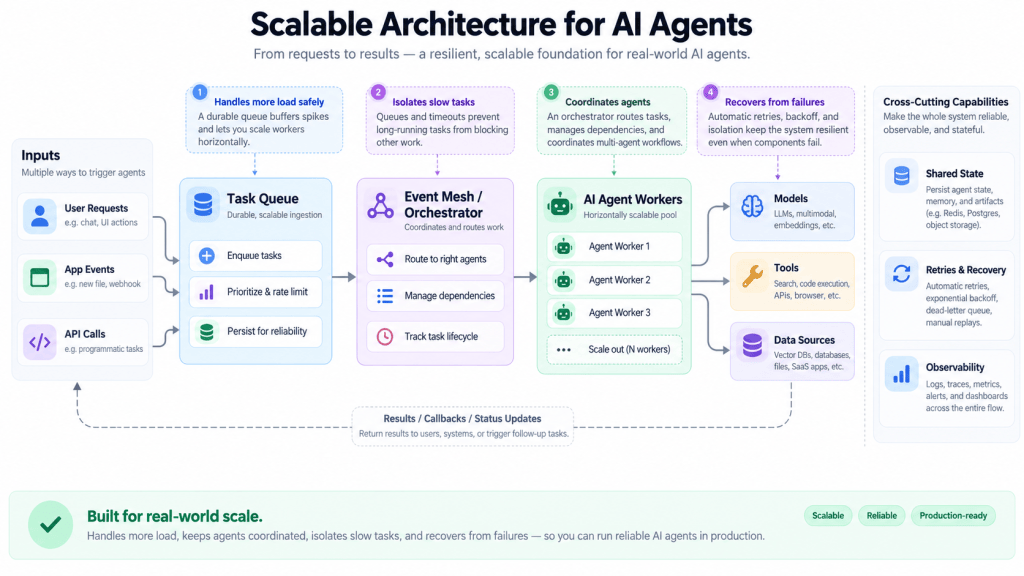
Why Most Agent Setups Break Under Load
The usual culprit isn’t the model. It’s the plumbing around it. Direct API calls, no queue, no retry logic. One slow response backs up every request behind it.
Teams often try to fix this by building distributed agent systems from scratch. They wire together queues, brokers, and custom coordination code. It works for a while, then someone has to maintain three different services just to keep messages flowing.
The real fix isn’t more infrastructure. It’s the right AI workload architecture from day one.
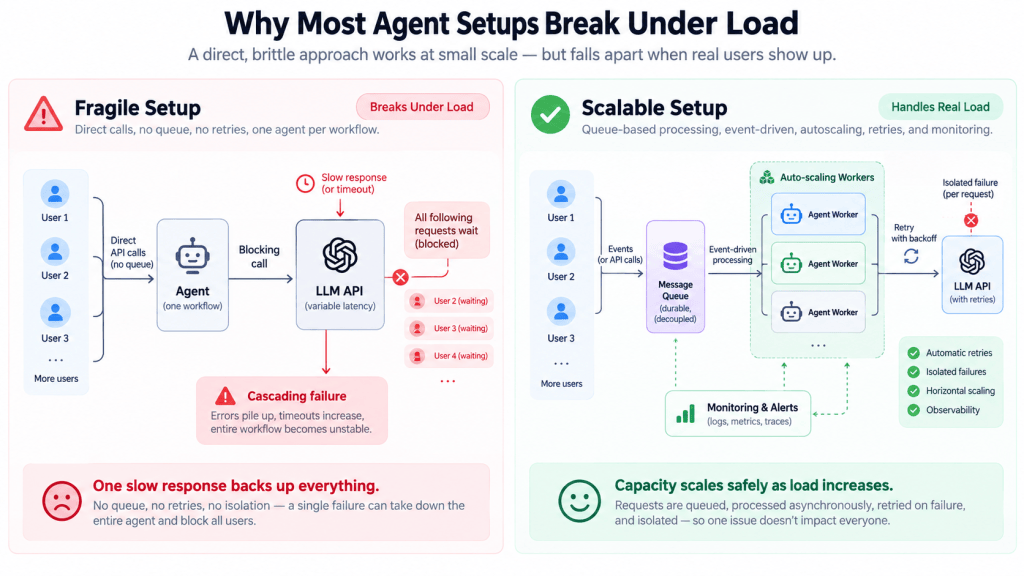
The Building Blocks of a Scalable Agent Platform
A scalable agent platform needs four things. A queue for incoming tasks. Workers to run them. A way for agents to talk to each other. And a way to see what’s happening when something breaks.
Task queues stop one slow agent from blocking everyone else. AI agent workers pick up jobs as capacity frees up, not all at once. Shared state lets agents pass context without duplicating work. Monitoring shows you where the bottleneck actually is before users notice.
Event-Driven Design Is the Backbone
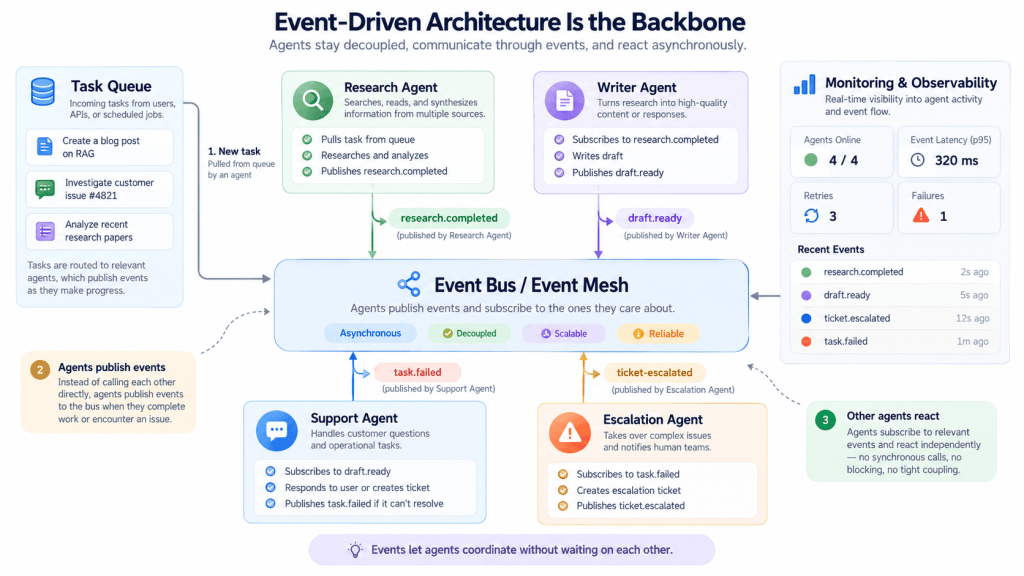
An event-driven scalable architecture doesn’t wait for one task to finish before starting the next. Agents publish events. Other agents subscribe and react. Nothing sits in a blocking queue waiting its turn.
This matters most when agents depend on each other. A research agent finishes, a writing agent picks up the output, a support agent escalates when needed. Each step fires as an event, not a phone call waiting on hold.
Where AI Agent Workers Fit In
AI agent workers are the units that actually do the work. They pick a task off the queue, run it, then report back. Scaling isn’t about writing more code. It’s about running more workers safely, without them stepping on each other’s tasks.
Add workers as load increases. Remove them when it drops. That elasticity is what separates a scalable agent platform from a fixed pipeline that either sits idle or falls over. Good architecture treats capacity as a dial, not a fixed number.
How DNotifier Handles Scale
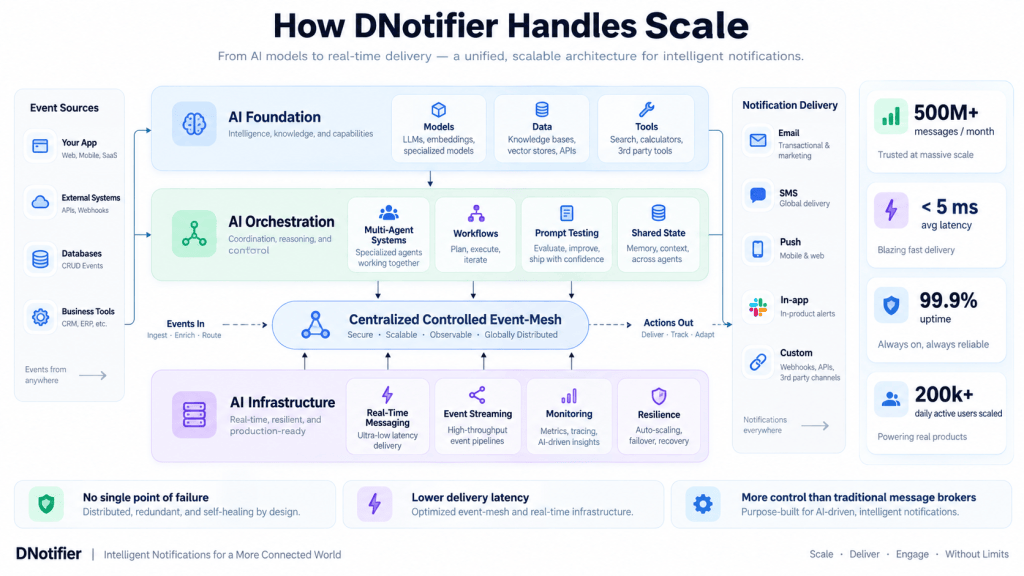
DNotifier runs on a centralized, controlled event-mesh instead of a sprawling web of separate services. Agents publish and subscribe to real-time events through one SDK. No stitching together five separate tools just to pass a message.
The platform is built in three layers. AI Foundation connects your models, data, and tools. AI Orchestration handles multi-agent systems, workflows, and prompt testing. AI Infrastructure runs the real-time messaging, monitoring, and event streaming underneath it all.
That structure is what makes it a scalable AI architecture in practice, not just on paper. DNotifier handles over 500 million messages a month with average latency under 5 milliseconds and 99.9% uptime. Teams report scaling past 200,000 daily active users without rewriting their coordination layer.
The resilience comes from design, not luck. No single point of failure. Lower message delivery latency. More control than traditional message brokers. That’s what high-scale AI infrastructure looks like when it’s built for the job, not bolted on after launch.
If you’re weighing an AI agent scalability architecture for your product, that’s worth starting from here.
Common Mistakes That Kill Scalability
Building agents one at a time without a shared communication layer is the most common mistake. Every new agent means new custom code to plug it in.
Skipping observability is another. You can’t fix what you can’t see, and by the time users complain, the damage is done.
Ignoring elastic AI agent workers is a third. Fixed capacity means you either pay for idle workers or bottleneck during spikes.
The last one is treating scale as a later problem. Retrofitting a scalable architecture into a live system costs far more than planning for it early.
FAQ
What’s the difference between scalable architecture and just adding more servers?
More servers help with raw compute, not coordination. Scalable architecture handles how agents talk, queue tasks, and recover from failure. Servers alone won’t fix a broken communication layer.
Do I need a distributed system to scale AI agents?
Not necessarily. A centralized, well-designed event-mesh can scale just as well, without the maintenance overhead of running several separate services yourself.
How do AI agent workers help with scaling?
Workers pull tasks from a queue as capacity allows, instead of processing everything at once. This keeps one slow task from blocking the rest of your system.
Is event-driven architecture harder to build than request-response?
It takes more upfront thought, but it pays off once agents start depending on each other. Request-response setups tend to buckle first under real load.
Final Thought
Scalable architecture isn’t a feature you bolt on later. It’s the decision that determines whether your agents grow with your product or become the reason it stalls.
If you’re building multi-agent systems and want the coordination layer already solved, take a look at dnotifier.com.

