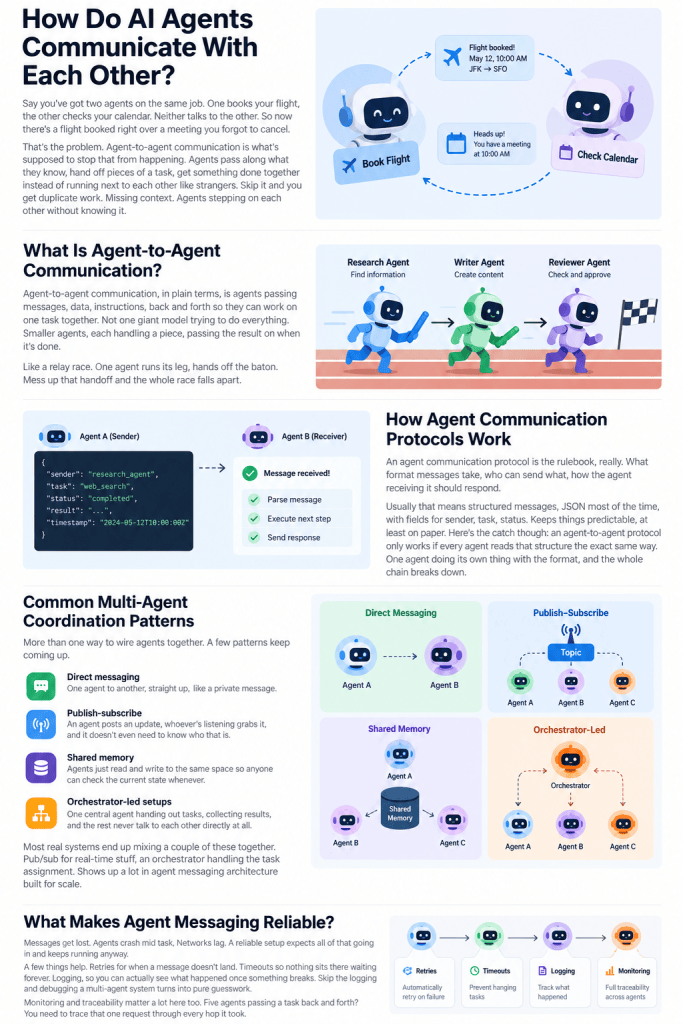
Say you’ve got two agents on the same job. One books your flight, the other checks your calendar. Neither talks to the other. So now there’s a flight booked right over a meeting you forgot to cancel.
That’s the problem. Agent-to-agent communication is what’s supposed to stop that from happening. Agents pass along what they know, hand off pieces of a task, get something done together instead of running next to each other like strangers. Skip it and you get duplicate work. Missing context. Agents stepping on each other without knowing it.
Here’s how it actually works.
What Is Agent-to-Agent Communication?
Agent-to-agent communication, in plain terms, is agents passing messages, data, instructions, back and forth so they can work on one task together. Not one giant model trying to do everything. Smaller agents, each handling a piece, passing the result on when it’s done.
Like a relay race. One agent runs its leg, hands off the baton. Mess up that handoff and the whole race falls apart.
Why Do Agents Need to Talk at All?
One agent, working alone? Fine. No coordination needed there.
Add a second agent and suddenly you need rules. Who does what. When. In what order. Skip that and agents duplicate work, or sit there waiting on each other forever.
Multi-agent communication fixes this part. Agents get a shared way to report progress, ask for help, pass context along. One researches. One writes. One checks the output before it goes out. None of it works if they can’t tell each other what’s already done.
How Agent Communication Protocols Work
An agent communication protocol is the rulebook, really. What format messages take, who can send what, how the agent receiving it should respond.
Usually that means structured messages, JSON most of the time, with fields for sender, task, status. Keeps things predictable, at least on paper. Here’s the catch though: an agent-to-agent protocol only works if every agent reads that structure the exact same way. One agent doing its own thing with the format, and the whole chain breaks down.
Common Multi-Agent Coordination Patterns
More than one way to wire agents together. A few patterns keep coming up.
Direct messaging’s the simplest one. One agent to another, straight up, like a private message. Publish-subscribe is different. An agent posts an update, whoever’s listening grabs it, and it doesn’t even need to know who that is. Shared memory skips messaging entirely, agents just read and write to the same space so anyone can check the current state whenever.
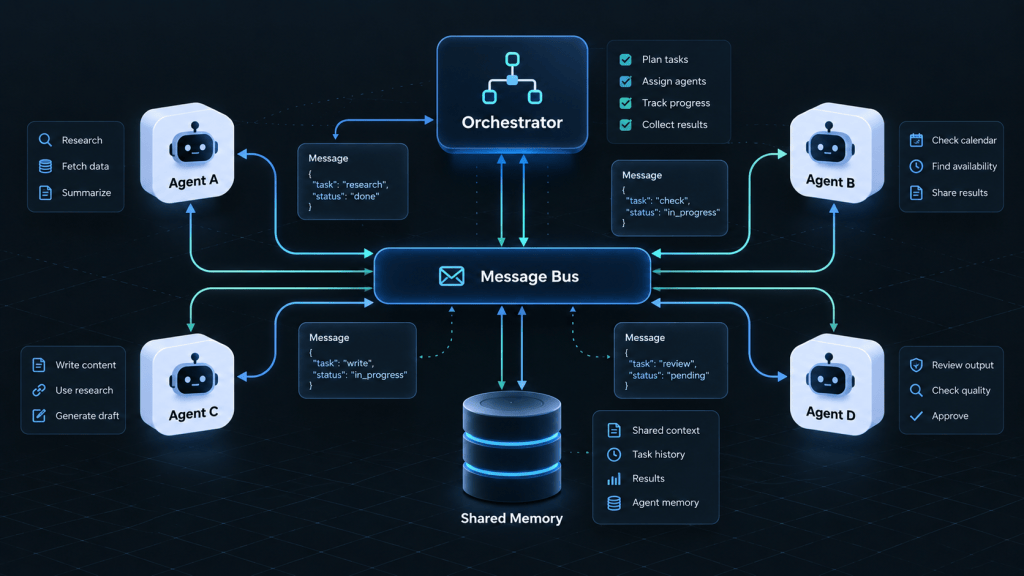
Then orchestrator-led setups. One central agent handing out tasks, collecting results, and the rest never talk to each other directly at all.
Most real systems end up mixing a couple of these together. Pub/sub for real-time stuff, an orchestrator handling the task assignment. Shows up a lot in agent messaging architecture built for scale.
What Makes Agent Messaging Reliable?
Messages get lost. Agents crash mid task. Networks lag. A reliable setup expects all of that going in and keeps running anyway.
A few things help. Retries for when a message doesn’t land. Timeouts so nothing sits there waiting forever. Logging, so you can actually see what happened once something breaks. Skip the logging and debugging a multi-agent system turns into pure guesswork.
Monitoring and traceability matter a lot here too. Five agents passing a task back and forth? You need to trace that one request through every hop it took.
Where DNotifier Fits In
Past two or three agents, distributed agent communication across all those services gets hard to manage by hand. You end up gluing together separate tools, one for messaging, one for monitoring, one for orchestration, and every extra tool is something else that can quietly break on you.
DNotifier runs all of it through one SDK, one API. No pile of separate services. Real-time pub/sub means agents publish updates the second they happen. Monitoring and traceability are already built in, so when something fails you can actually see where instead of guessing. Multi-agent workflows, orchestration, prompt testing, same system, all of it. Agent collaboration infrastructure isn’t something bolted on after the fact here. It’s just part of how the thing runs.
Common Coordination Mistakes
Same mistakes, over and over. Teams skip a shared protocol, let each agent format messages however it wants. Works fine for a while. Then it doesn’t.
Others just keep adding agents without adding any monitoring. Failures sit there, unnoticed, until a user complains.
The big one though: treating coordination like an afterthought. It has to be part of the design from day one, not something patched in once agents start tripping over each other.
FAQ
What is an AI agent communication protocol?
The rulebook agents follow for sending and reading messages. Format, required fields, how to respond to what comes in.
Is agent-to-agent communication the same as multi-agent coordination?
Not really, no. Communication is the messages. Coordination’s the bigger picture, how agents organize tasks and timing using those messages.
Can agents built on different models talk to each other?
Yes, as long as they’re following the same protocol. What model’s underneath barely matters if the message format stays consistent.
Do I need special infrastructure for agent messaging?
Probably not for just a couple of agents. Once there are several running with real dependencies between them though, dedicated infrastructure saves a lot of debugging time down the line.
Agents that can’t talk to each other, that’s not really a system. Just scripts running near each other, not with each other. Real coordination takes a shared protocol, messaging that doesn’t fall over, and enough visibility to actually know what’s happening.
Building agents meant to work together, not just run side by side? DNotifier’s worth a look. One SDK, one API, messaging and monitoring already built in.
Explore it at dnotifier.com.
 DNOTIFIER BLOGS