You built three agents. One researches, one writes, one checks facts. Each handles its own step in a multi step task. Problem is, they don’t talk to each other.
The writer starts before the research’s even done. The checker never sees the final draft. Nobody knows what anyone else just did.
That’s exactly the problem AI agent messaging solves. It gives agents a way to pass information to each other as they work. One agent’s output becomes another agent’s input, no manual stitching required.
What Agent-to-Agent Messaging Actually Means
Agent-to-agent messaging is how one agent sends data or results to another. Usually through a shared channel, not by calling the other agent’s code directly. Agent A doesn’t reach into Agent B’s function. It sends a message instead. Agent B picks it up whenever it’s ready.
That shared channel is really an agent messaging protocol. It defines how agents work together, not just how each one runs solo. Message shape, sender permissions, who’s subscribed to what. Skip that structure and you get agents shouting into the void, hoping someone’s listening.
Why Agents Need to Talk at All
A single agent doing one job? Doesn’t need any of this. This is basically what AI agent messaging is for, keeping separate steps in sync once agents start depending on each other’s work, especially as agent capabilities keep expanding and workflows get more tangled.
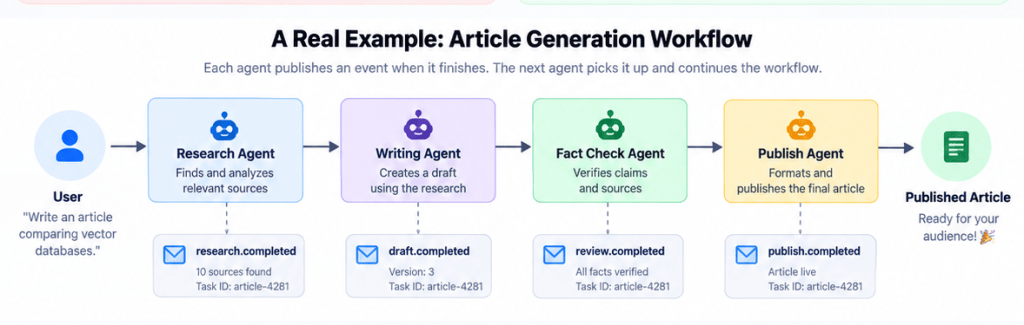
Think research, drafting, and review as separate steps that still need to stay lined up. Say your research agent pulls ten sources. Your writing agent shouldn’t start before that’s done, and it definitely shouldn’t be polling a database every two seconds asking “done yet? done yet?”
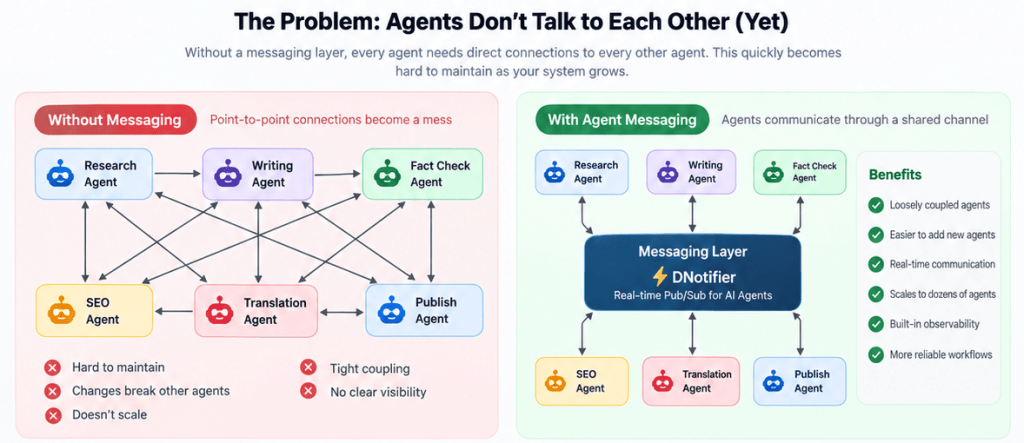
This is where things quietly fall apart in production, by the way. Teams wire two or three agents together with direct function calls. Works fine in a demo. Then real agent workloads show up, someone adds a fourth agent, and the whole thing turns into a tangle nobody wants to touch.
How the Messaging Actually Works
Under the hood, an agent communication layer usually runs on publish-and-subscribe. Agent publishes a message to a topic. Any agent subscribed to that topic gets it. Nobody needs to know who else is listening, which is kind of the point.
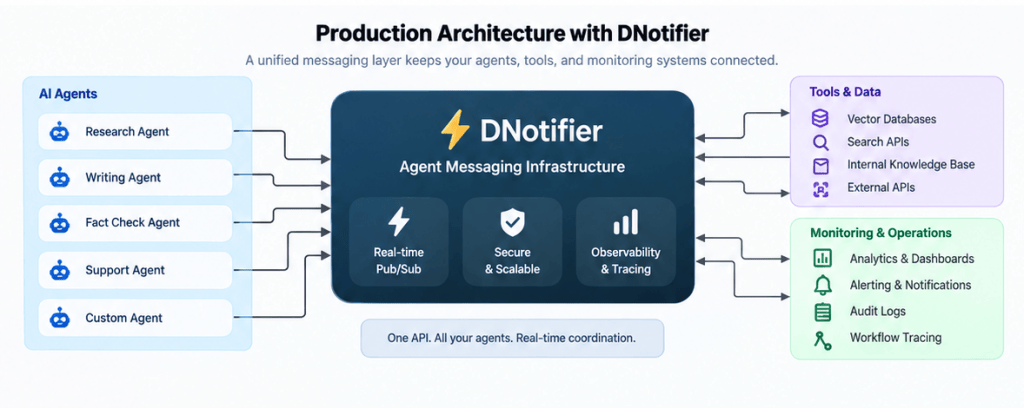
This is where DNotifier’s real-time pub/sub comes in. Built as agent native infrastructure from the ground up, not bolted onto something older. Agents publish events, subscribe to exactly what they need, and the whole exchange runs through one API instead of a dozen custom integrations. No building a message queue from scratch every time you add an agent to the platform.
Some people call this distributed agent messaging, since the agents themselves might be spread across different services or even different models. Fair enough. But the messaging layer holding it together doesn’t have to be a mess of moving parts. With a unified SDK underneath, that coordination stays centralized and easy to reason about, even as an agent platform grows to handle dozens of agents at once.
Common Messaging Patterns Worth Knowing
Most agent-to-agent messaging protocol setups fall into a handful of patterns. Request-response is the simplest: one agent asks, another answers. Easy to build. Also creates waiting, which slows everything down.
Event-driven messaging shows up more in real systems. Agents don’t sit around. They react when something happens. Research agent finishes, fires an event, writing agent picks it up whenever it’s free.
Broadcast messaging works for monitoring and logging. One agent publishes status updates. Any number of other agents or dashboards can listen in, no extra setup needed on the sender’s side.
Where Real-Time Matters Most
Real-time agent messaging isn’t a nice-to-have when agents handle live conversations, fast-moving data, or anything time-sensitive. An autonomous ai agent escalating a support ticket to a specialist can’t afford a ten-second lag. Neither can a trading or monitoring system reacting to fresh data.
Fully autonomous agentic systems raise the stakes even higher, since there’s no human in the loop to catch a missed message. This is where monitoring and traceability earn their keep too. Five agents passing messages back and forth? You need the full trail. What got sent, what got dropped, where a delay crept in. Good agent communication infrastructure gives you that visibility instead of leaving you to guess.
Designing a Messaging Architecture That Holds Up
A solid AI messaging architecture isn’t about piling on more moving parts. It’s about giving every agent one clear way to send and receive messages, so adding a new agent doesn’t mean rewiring the ones already working.
Keep the message format simple and consistent. Let every agent subscribe only to what it actually needs, nothing more. If your agents also pull context from vector databases for retrieval, make sure that lookup step fires its own event too, so the rest of the pipeline knows fresh context just landed. And track the traffic. A messaging layer you can’t observe is a messaging layer you can’t debug at 2am.
FAQs
Is agent-to-agent messaging the same as an API call?
No. An API call is direct and one-to-one, with the caller sitting there waiting on a response. AI agent messaging is usually asynchronous, and it can reach multiple listeners through one shared channel.
Do all multi-agent systems need messaging?
Not always. A simple two-agent pipeline gets by fine with direct calls. Once you’re running three or more agents with real dependencies between them, messaging is what keeps things from getting fragile.
What breaks without a proper messaging layer?
Agents duplicate work. They miss updates. They act on stale data without knowing it. Debugging turns painful fast, since there’s no single place to see who sent what and when.
Does real-time messaging slow down my system?
Done right, it speeds things up. Agents react the moment something happens instead of polling over and over, which cuts wasted requests and latency.
Once you get AI agent messaging right, coordination stops being the hard part. If you want to see this working with real agents instead of a diagram, DNotifier’s pub/sub is worth a look at dnotifier.com.
 DNOTIFIER BLOGS