If you’ve built more than one agent, you already know the problem. Each one works fine on its own. Connect a few together, and things get messy fast. Context gets lost between calls. Agents can’t find each other. Nobody can trace what actually happened. This is the exact problem an agent mesh is built to solve.
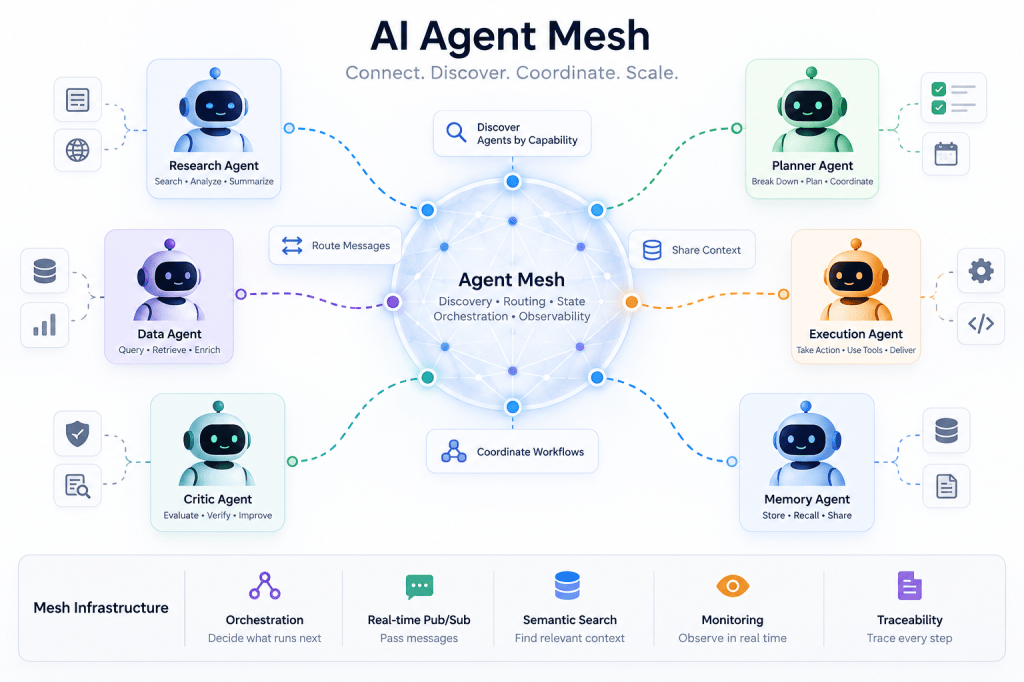
An agent mesh is a connectivity layer that lets autonomous agents discover, talk to, and coordinate with each other. Think of it as the network fabric behind any serious multi-agent network. Instead of hardwiring every agent to every other agent, the mesh handles routing, discovery, and communication for you.
Why Agents Need a Mesh Layer
Most teams start with a single agent. It works, so they add another. Then another. Soon they’re running a small AI agent network with no shared structure holding it together.
That’s where things fall apart. Without a mesh layer, every new agent means new integration work. Every added agent workload creates more point-to-point connections to manage by hand. This turns into a tangle fast, and it’s the classic sign of an agent network architecture built without a real plan.
An agent mesh architecture fixes this by giving every agent one consistent way to connect. Agents advertise their agent capabilities. Other agents discover and call them automatically. Nobody has to hand-build a custom agent network architecture for every new project.
How an Agent Mesh Works
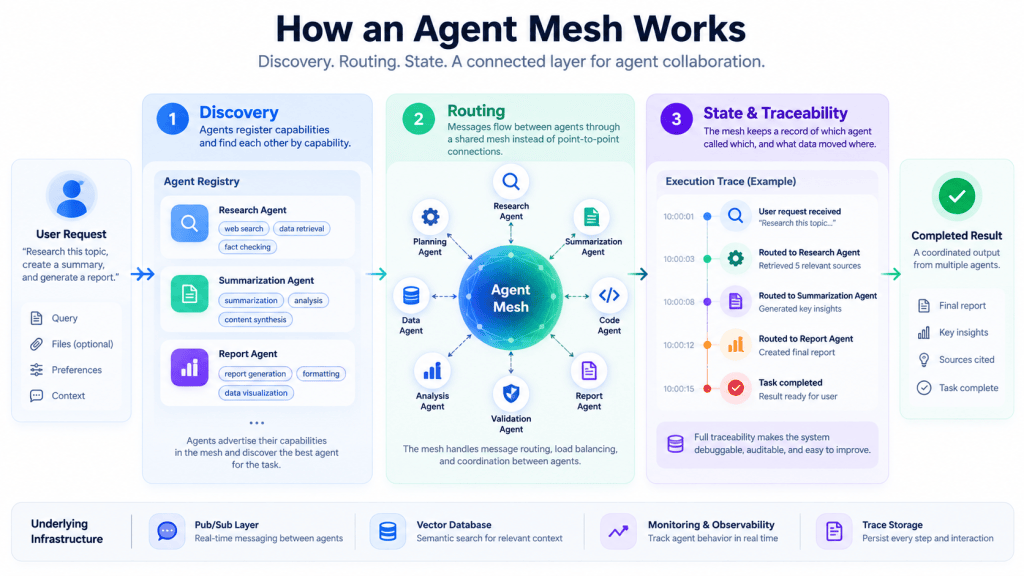
At its core, an agent mesh handles three jobs: discovery, routing, and state.
Discovery means agents find each other by capability, not by hardcoded address. An agent looking for a summarization tool can query the mesh and get one back automatically. This is what makes agent-native systems possible in the first place.
Routing moves messages between agents through a shared layer instead of direct connections. This is what makes multi-step workflows work smoothly. One agent hands off to the next without either one needing to know the other’s internals.
State is what makes it all trackable. The mesh keeps a record of which agent called which, and what data moved where. This is what makes an autonomous agent network debuggable instead of a black box you can’t explain to your team.
Under the hood, most agent mesh setups lean on a few core pieces: a pub/sub layer for messaging, vector databases for semantic lookups, and a monitoring layer watching it all in real time.
Core Pieces of an Agent Mesh
A working agent mesh architecture usually includes:
- Orchestration, to decide which agent runs next and when
- Real-time pub/sub, to pass messages without constant polling
- Semantic search, backed by vector databases, so agents find relevant context on their own
- Monitoring and observability, to watch agent behavior as it runs
- Traceability, to trace every step back to its source
Skip observability, and you can’t tell why an agent failed. Skip semantic search, and agents can’t pull relevant context without help. Together, these pieces form the real agent infrastructure mesh behind any serious agent platform, and the backbone of a multi-agent network that can actually scale.
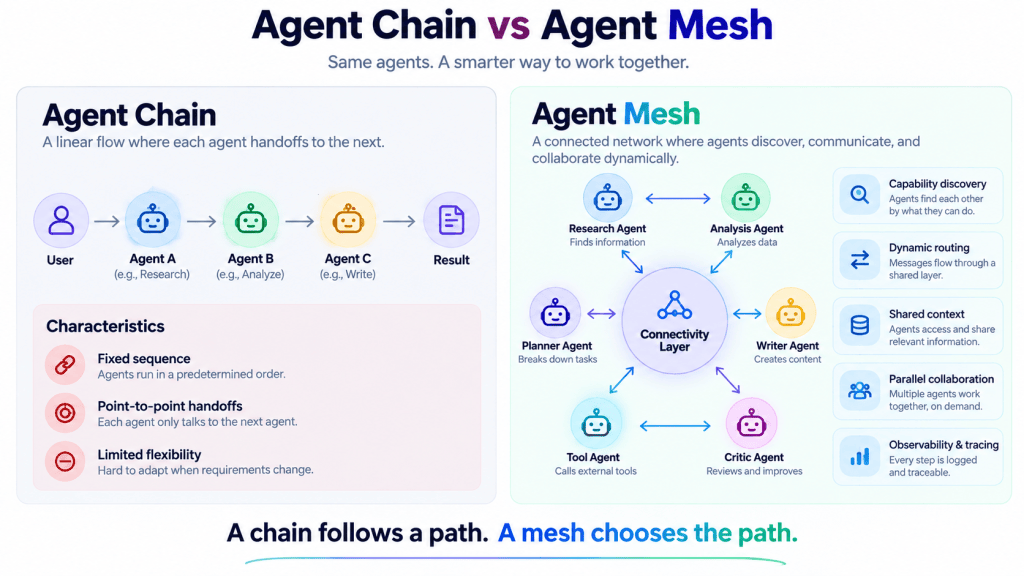
This is also where a simple agent chain differs from a true mesh. A chain just passes output forward, one step at a time. A mesh lets any agent talk to any other agent, on demand, based on what the task needs at that moment.
Signs You’re Ready for One
Not sure if you need this layer yet? A few signs make it obvious. Your agents work fine alone, but coordination between them keeps breaking. You’ve hardcoded connections between every pair, and adding one more means touching all of them. Nobody can explain why a specific run failed. You’re duplicating context because agents can’t share it on their own. Any of these, and it’s time to add a proper layer instead of more manual wiring. Waiting usually means rebuilding the whole agent platform later, under pressure, instead of setting it up right the first time.
Where DNotifier Fits In
Building this mesh layer from scratch is a lot of work. You’d need messaging, discovery, monitoring, and tracing, all built and maintained separately, on top of whatever agents you’re already running.
DNotifier gives you that layer through one SDK and one API. It handles agent orchestration, real-time pub/sub, semantic search, and full traceability, so you’re not stitching together five different tools just to get agents talking.
If you’re building agent-native products, meaning autonomous agentic behavior sits at the center of what you’re building rather than bolted on later, AI agent connectivity matters even more. DNotifier gives your agents shared, native infrastructure to coordinate through, without you managing the plumbing yourself.
FAQs
What is an agent mesh in simple terms?
An agent mesh is a layer that connects agents so they can find and talk to each other. It handles discovery, routing, and coordination automatically.
How is an agent mesh different from a multi-agent system?
A multi-agent system is the group of agents working together. It’s the connectivity layer that makes their coordination possible at scale.
Do I need an agent mesh for a single agent?
No. A mesh matters once you’re running multiple agents that need to discover each other, share context, or hand off tasks mid-workflow.
Does an agent mesh require distributed infrastructure?
Not necessarily. Some agent mesh setups run on a distributed agent network. Others, like DNotifier, centralize orchestration and connectivity in one platform instead.
Can an agent mesh handle non-AI workloads too?
Yes, to a point. The routing and discovery layer works for any autonomous AI component, not just language model agents, as long as it can publish and call capabilities.
Final Thought
An agent mesh isn’t a buzzword. It’s the layer that lets agents actually work together instead of just sitting next to each other doing their own thing. If you’re scaling past one or two agents, it’s worth having one in place before the tangle starts.
Want to see how it works in practice? Explore the SDK at dnotifier.com.
 DNOTIFIER BLOGS