Enterprise AI governance sounds abstract until an agent does something you can’t explain. Then it’s the only thing standing between you and a very uncomfortable meeting. In practice, it’s policies, permissions, and audit trails working together. What can an agent do. Who signed off on it. Can you actually prove what happened afterward. Without answers to those three, an agent is just a fast guess running in production.
Why Agent Governance Matters Now
A single agent making a bad call used to mean a support ticket. Now it can mean a compliance incident. Agents touch customer data. They trigger payments. They write to production systems. One ungoverned action can cascade through a dozen downstream processes before anyone even notices.
Regulators are catching up too. Financial services already face audit requirements for automated decisions. So does healthcare. So does anything brushing up against the public sector. An agent governance framework isn’t a nice-to-have anymore. It’s baseline.
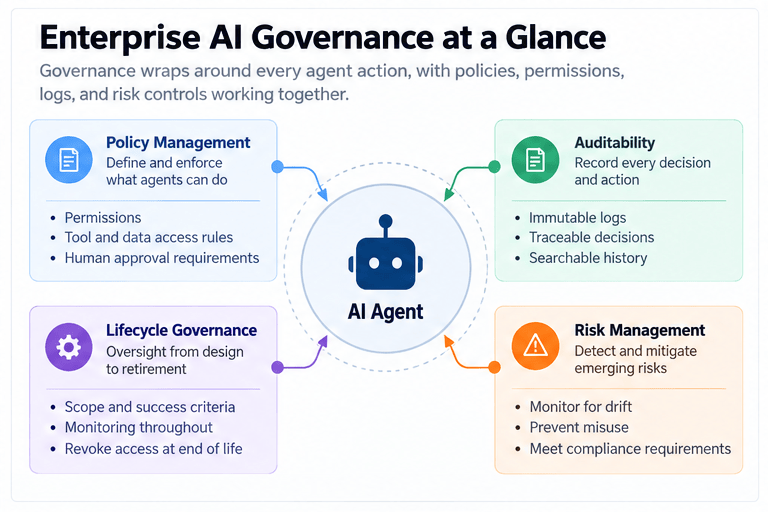
Four Pillars of an Agent Governance Framework
Most governance programs come down to four working parts. Skip one, and the other three get shakier fast.
| Pillar | What It Covers | What Fails Without It |
|---|---|---|
| Policy management | Rules for what agents can and can’t do | Agents overstep their intended role |
| Auditability | Logs of every decision and action | No way to reconstruct what happened |
| Lifecycle governance | Oversight from design to retirement | Old agents keep running unmonitored |
| Risk management | Ongoing checks for drift and misuse | Small issues turn into major incidents |
AI Agent Policy Management
Policy management is the unglamorous part nobody wants to do first. It’s also the part that saves you later. It means deciding what an agent can do before it ever runs, not after it’s already caused a mess. What tools it can call. What data it can touch. Whether an action needs a human to sign off first.
Good policy management doesn’t live in a wiki nobody opens. It runs at deploy time, so an agent can’t quietly wander outside its lane. This is where prompt testing pulls its weight. Run an agent’s responses against real policy rules before launch, and you catch problems while they’re still cheap.
AI Agent Audit Logs and Auditability
Ask any team that’s had to explain an agent’s decision after the fact: audit logs aren’t optional. Auditability just means the record is complete, hard to tamper with, and searchable the moment someone finally asks the hard question.
That’s what matters mid-incident. When a customer disputes a decision, “we think it worked correctly” doesn’t hold up, not with a regulator, not with the customer either. Traceability turns agent behavior into something you can point to, not something you hope happened. Monitoring that captures every request and response builds that trail on its own, so your team isn’t reconstructing it from memory later.
Agent Lifecycle Governance
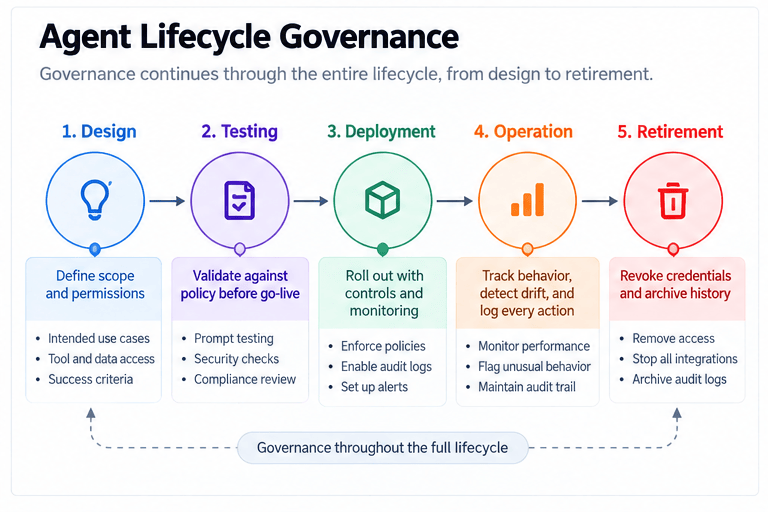
Agents don’t stay the same. Prompts get tweaked. Models get swapped. New tools get bolted on. Lifecycle governance is what keeps oversight running through all of that, not just at launch day.
| Stage | Governance Focus |
|---|---|
| Design | Define scope, permissions, and success criteria |
| Testing | Validate against policy before go-live |
| Deployment | Roll out with monitoring active from day one |
| Operation | Track behavior, flag drift, log every action |
| Retirement | Revoke access and archive audit history |
Skipping that last stage is the mistake almost everyone makes. An old agent still holding live credentials, quietly running in the background, is a liability nobody’s watching.
AI Agent Compliance and Risk Management
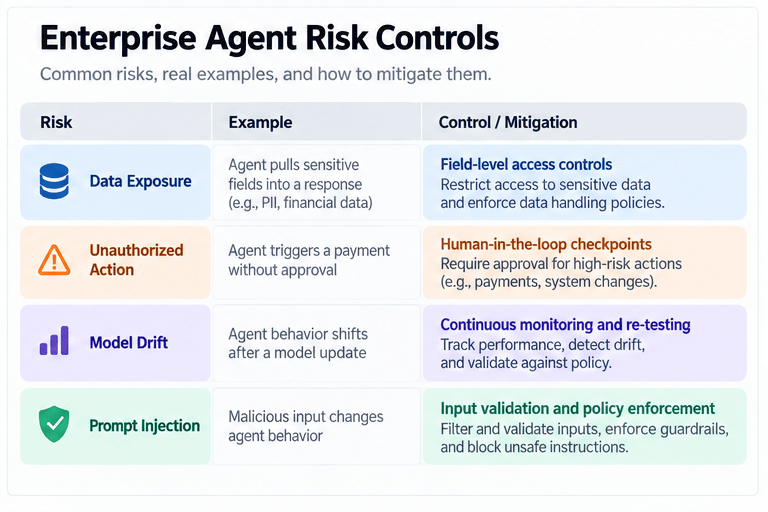
Compliance is basically a test: can your automated decisions survive a regulator’s questions? AI agent risk management is everything you do to make sure the answer stays yes.
| Risk | Example | Mitigation |
|---|---|---|
| Data exposure | Agent pulls sensitive fields into a response | Field-level access controls |
| Unauthorized action | Agent triggers a payment without approval | Human-in-the-loop checkpoints |
| Model drift | Agent behavior shifts after a model update | Continuous monitoring and re-testing |
| Prompt injection | Malicious input changes agent behavior | Input validation and policy enforcement |
None of this is hypothetical. It’s the actual reason enterprise agent policies exist.
Building Enterprise Agent Policies That Scale
A policy that works for one agent rarely survives fifty. Add more agents and policies need to hold up at scale, especially in multi-agent setups where agents are calling other agents and passing context back and forth.
That’s easier with one point of control. Instead of managing rules agent by agent, DNotifier gives you a single control plane to enforce policy, watch activity, and trace decisions across the whole system. One place, not fifty dashboards. Real-time pub/sub keeps every action visible as it happens, so governance isn’t something you check on later, it’s just how the system runs.
FAQ
Does agent governance slow down deployment?
Not really. Policies enforced at runtime add checks, not delays. The real slowdown shows up when governance gets bolted on after agents are already live and already causing problems.
Who owns AI agent governance inside a company?
Rarely just one team. Engineering builds the guardrails, compliance writes the rules, security watches for misuse.
How often should agent policies be reviewed?
Whenever the agent changes. New scope, new tools, a swapped-out model, any of that counts. Quarterly is a reasonable floor even when nothing obvious has changed.
What’s the difference between monitoring and auditability?
Monitoring is real time. Auditability is the record afterward. One tells you what’s happening now, the other proves what already happened, and you need both.
Closing Thought
Agents are only getting more autonomy, not less. The companies governing them well now won’t be the ones scrambling to explain a bad decision six months from now. If you’re building agents that need real oversight, take a look at how DNotifier handles policy, monitoring, and traceability in one place, at http://www.dnotifier.com.

