DeepInfra runs models. That’s its job in an agent stack: you send a prompt, you get a completion. It doesn’t decide which agent goes next or how agents pass results around. Orchestration and messaging live in another layer.
People blur these two all the time. Then the design looks distributed on a diagram but acts like one big loop in production. Let’s pull the layers apart.
Inference vs Orchestration
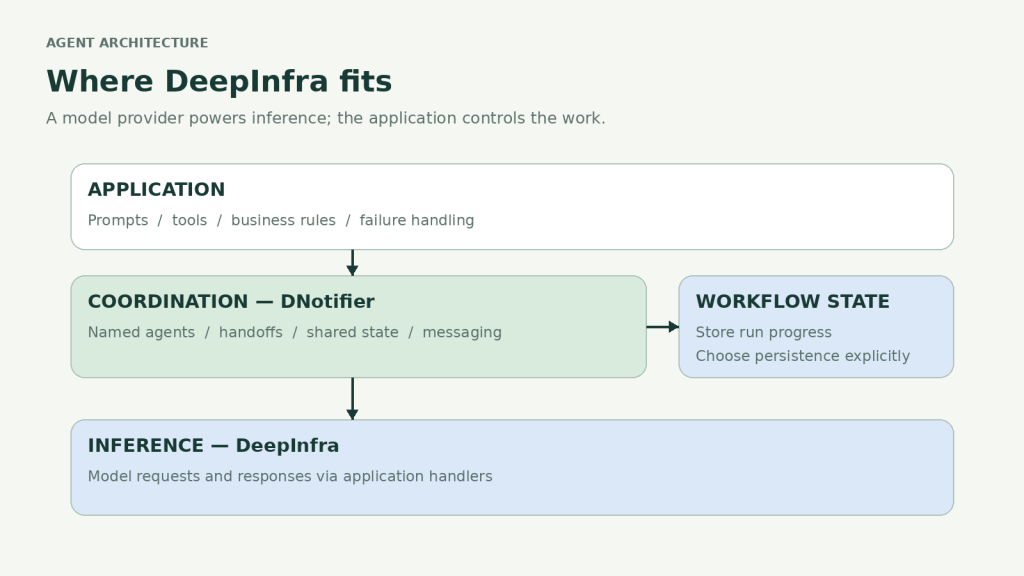
Inference is one request to a model and one response back. Orchestration is the part that decides what runs, in what order, and who gets the result. Both touch models, but they’re different jobs.
Here’s a shortcut I see a lot in architecture talks. A team calls one model API five times with five prompts. Then they call it a multi-agent system. It isn’t. Different prompts don’t make different agents, and neither do several model providers.
Is that wrong? Not always. A single agent loop works fine for plenty of tasks. One model plans, calls a tool, reads the output, tries again. If the task is narrow and uses one toolset, that loop is easy to build and easy to debug. Keep it.
Distinct agents earn their place when the work splits into real roles. Each one gets its own tools, its own context, and a clear handoff. The same model can sit behind all of them. What separates the agents is the boundary you draw, not the model.
Execution vs Control
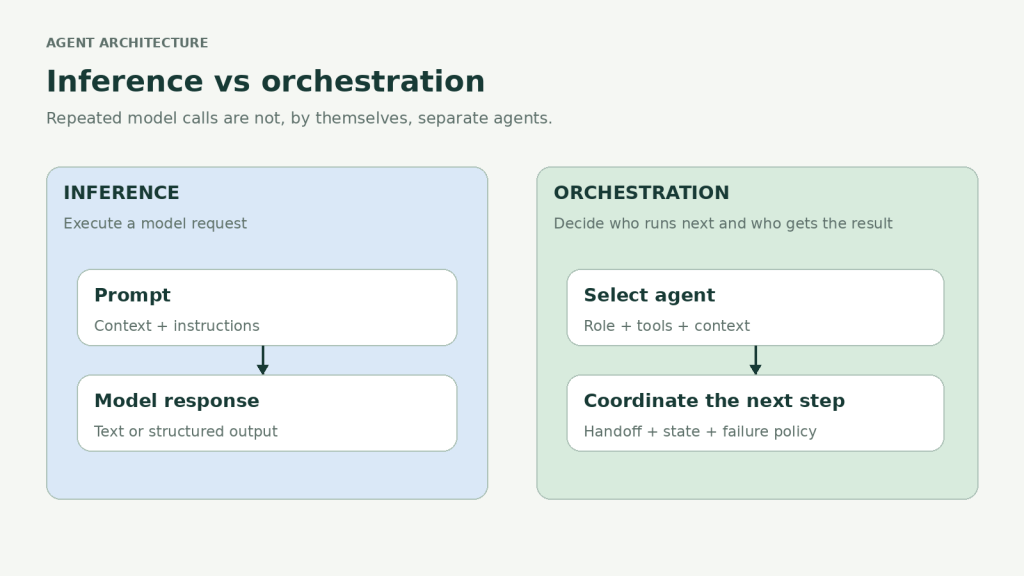
Most agent stacks carry four responsibilities:
- Model execution means sending requests to model providers.
- Orchestration means deciding execution order and coordinating work.
- Messaging means moving information between components.
- Application state means storing workflow data and tracking progress.
Execution handles a single request. Control handles everything around it: what comes next, which agent takes it, what happens when a call fails.
Keep them apart and you can swap a model provider without touching the workflow. Mash them together and a provider change turns into a rewrite. Any multi-agent design leans on this split.
State is the one people forget. Somebody has to hold intermediate results and track where a run stands. Decide early where that lives. Your app, your orchestration layer, or a bit of both.
DeepInfra Runs the Models
The DeepInfra documentation calls it an inference cloud with an OpenAI-compatible API. It lists over 100 language models, along with vision, embedding, and speech models. Private GPU deployments are on the menu too.
The docs also say you can point an OpenAI SDK at DeepInfra’s base URL and keep your existing code. So testing an open-source model doesn’t mean rewriting your client.
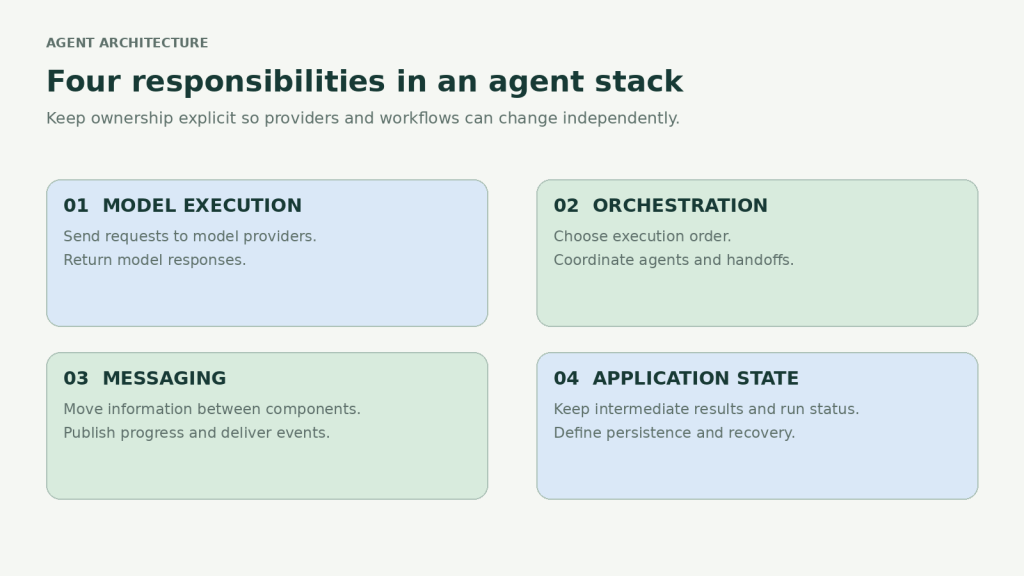
In an agent stack, that makes it the execution layer. Agents send prompts, DeepInfra sends completions back. Its documentation focuses on inference. Agent roles, handoffs, and workflow state? Those stay with you, or with another layer.
DNotifier Coordinates Agents
DNotifier provides one SDK and one API with multi-model support. It sits in the orchestration and messaging layers. It doesn’t run models for you.
The DNotifier Dart SDK documentation describes named agents created with defineAgent. A workflow registers them and shares state between them. One agent can call another through ctx.runAgent. Telemetry for executions and steps can show up in a workflow dashboard, and it’s optional. Real-time pub/sub and chat handle messaging, while semantic search handles retrieval.
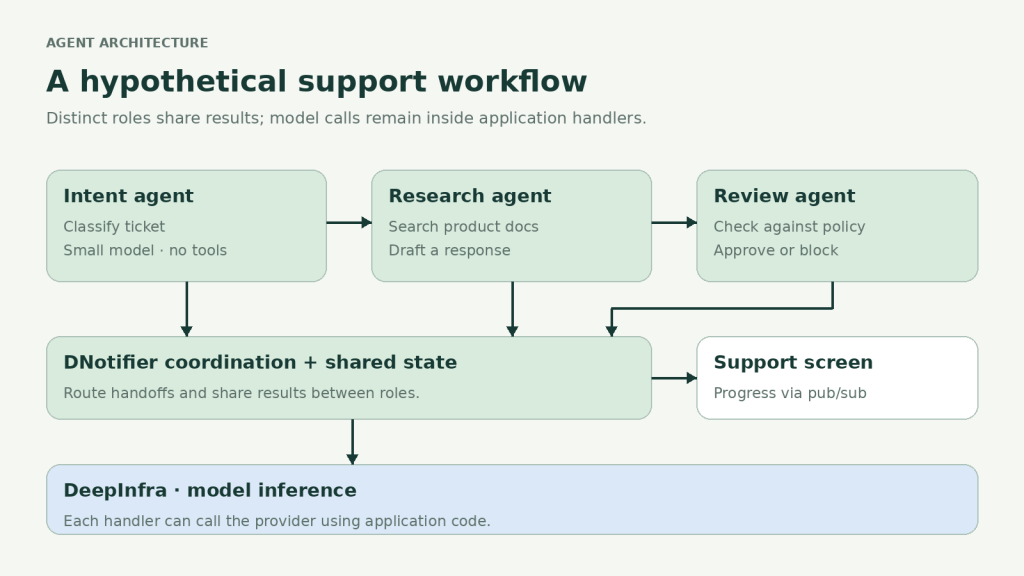
Here’s a hypothetical support workflow with three distinct agents:
- Intent agent: classifies the ticket. No tools, small model.
- Research agent: searches product docs with semantic search, then drafts an answer on a larger model.
- Review agent: checks the draft against policy. It can block the answer.
Results move through shared state. The workflow also pushes progress to the support screen over pub/sub. Every agent has its own role, tools, and context. Model calls could go to DeepInfra from inside each handler.
That last bit is plain application code. The documentation I reviewed doesn’t name DeepInfra as a built-in provider, so check before you count on it.
Who owns what? DNotifier handles coordination and message flow. Your application owns the prompts, the tool logic, the business rules, and failure handling. The model provider owns model quality, rate limits, and uptime. The documentation reviewed doesn’t confirm durable replay or automatic retries. Plan to build your own.
Now the trade-off. More layers means more moving parts. Two vendors, two sets of limits, two places to look when something breaks. You’ll also need to line up workflow telemetry with provider usage by hand. For a narrow task, one loop calling DeepInfra directly is simpler.
FAQ
Is DeepInfra an agent framework?
No. DeepInfra serves models through an API. Agent roles, handoffs, and workflow state aren’t part of it.
Can one model power several agents?
Yes. Agents differ by role, tools, context, and coordination. The model behind them can be identical.
When is a single loop enough?
When the task is narrow and uses one toolset. Add agents once roles, permissions, or review steps start to differ.
Choose an inference provider for model cost, speed, and catalog. Choose a control layer for how work moves between agents. If you want to see how named agents, shared state, and pub/sub fit together, take a look at DNotifier.