Your team says “harness.” Another team says “framework.” A vendor pitches a “platform.” Then someone says “infrastructure” and the meeting goes quiet.
These words get tossed around like they mean the same thing. They don’t. Mix them up and you buy the wrong tool, or miss a gap until production.
Here’s a plain take on agent harness vs framework. You’ll also see where platform and infrastructure fit, and how to pick.
How Does an Agent Harness Work?
An agent harness is the runtime code around one agent. It runs the loop, controls tools, tracks state, and sets limits. The model does the thinking. The harness decides what the model can touch and when it has to stop.
Most harnesses handle:
- The agent loop: think, act, check the result
- Which tools the agent can call
- What the agent remembers
- Timeouts and stop rules
- A log of each step
Picture the seatbelt and dashboard around an engine.
What an Agent Framework Gives You
An agent framework is a code library with building blocks for agents. It gives you patterns for prompts, tools, memory, and step chains. You put your agent together from those parts and ship faster.
A framework answers “how do I build this?” A harness answers “how do I run this without trouble?”
Plenty of frameworks ship a basic harness inside. That’s where the mix-up starts. A framework is a package. A harness is a job. One can hold the other.
The Core Difference
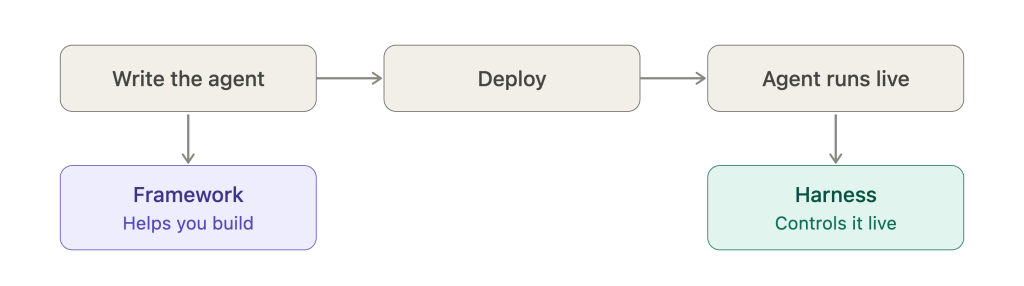
The agent harness vs framework split is about timing. A framework helps while you write the agent. A harness helps while the agent runs.
Here’s a quick agent harness vs framework comparison:
| Agent harness | Agent framework | |
|---|---|---|
| Main job | Run and control an agent | Build an agent |
| When it matters | Run time | Build time |
| Scope | One agent’s loop | Code structure and patterns |
| Key question | What can this agent do? | How do I put it together? |
| Problem it solves | Unsafe or runaway behavior | Slow, messy development |
The same idea works as a timeline.
There’s a trade-off here. A platform saves build time, but you work its way. A custom harness gives you full control, but every fix is yours.
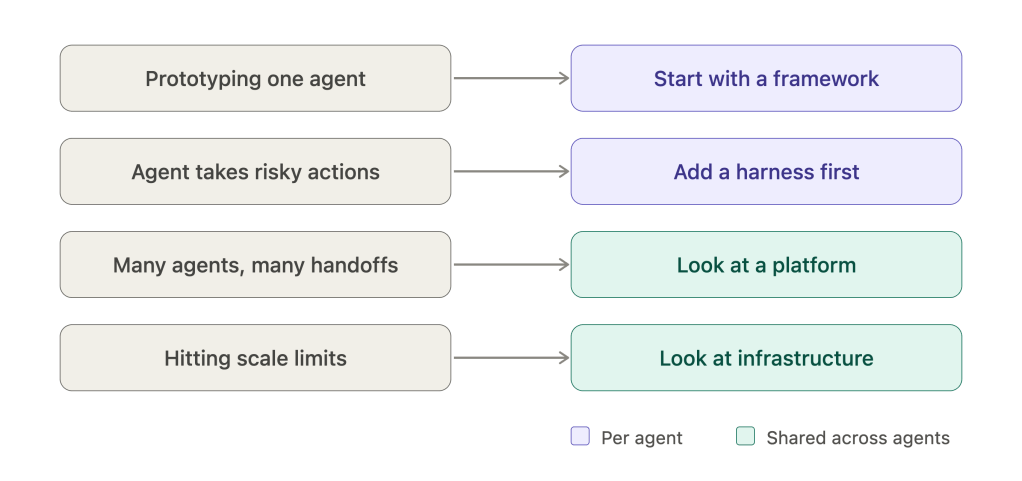
Pick based on how much control your team really needs.
FAQ
What is the main agent harness vs framework difference?
A framework helps you build an agent. A harness controls it while it runs. Frameworks give you structure. Harnesses give you limits, tool rules, and logs.
Do I need both a harness and a framework?
Most production teams end up with both. The framework speeds up development. The harness keeps behavior in check once the agent is live. Some frameworks bundle a basic harness, so check what yours includes.
Is a platform just infrastructure with a dashboard?
No. Infrastructure is the base layer, like storage and message delivery. A platform sits above it and adds coordination, monitoring, and tools your team uses every day.
Which should enterprise teams invest in first?
Start where your biggest risk sits. If one agent can take costly actions, begin with harness controls. If many agents must work together, begin with a platform.
Conclusion
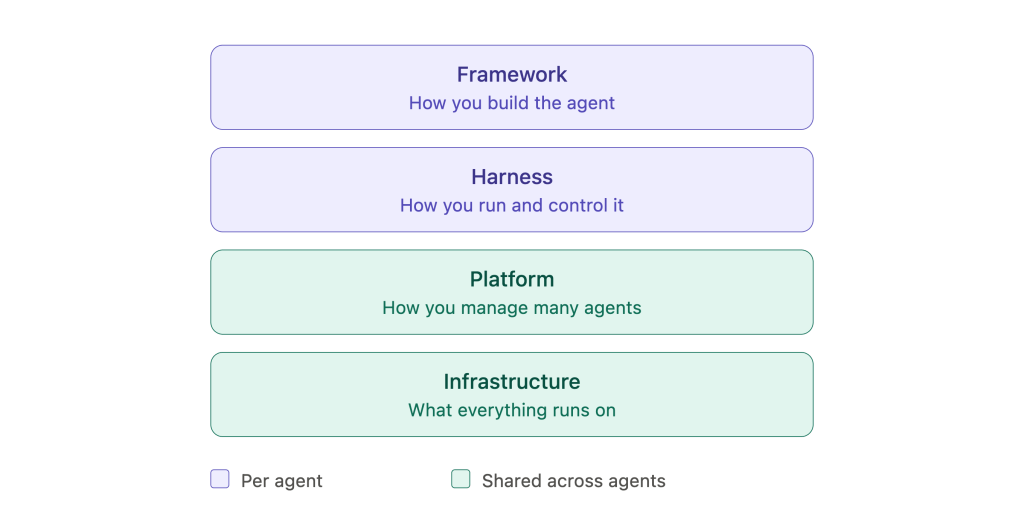
Frameworks help you build. Harnesses help you control. Platforms help you manage. Infrastructure helps you scale. Get the agent harness vs framework split right, and the rest gets easier.
Curious how one SDK and one API can cover the platform layer? Visit http://www.dnotifier.com and explore the SDK.

